This is a commonly encountered issue with Aria for Logs and although the guidance from Broadcom helps, there isn’t a permanent solution provided and this is where I make use of a Cron job.
What’s a cron job?
Cronjob is the Linux equivalent of a Windows scheduled task. It can be used to automate any action that can be performed within the OS.
I use the Crontab.guru expression scheduler to help create the schedule for what it is I want to do and then put the job into the local machines cronjob list.
Configuring a cron jobto remove .hprof files
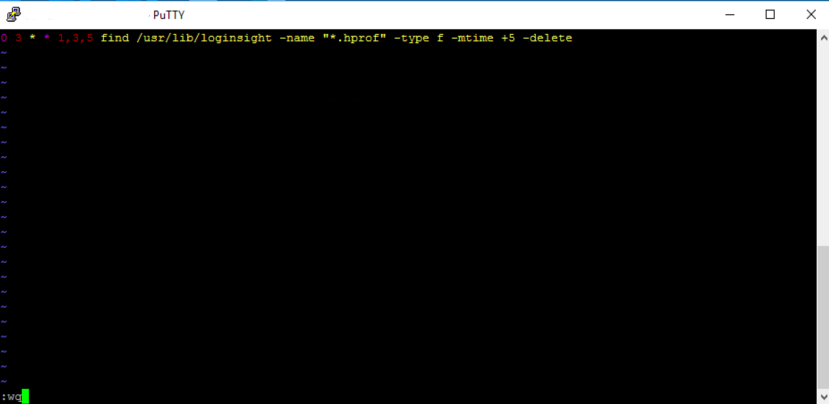
The syntax for the job is below and this invoke a task to search for .hprof files in /usr/lib/loginsight every Mon/Wed/Fri and then delete any that are older than 5 days.
I wanted to share the maintenance procedure I used recently for a customer. We needed to power down their Horizon workload clusters and gracefully place all instant clone desktops into a maintenance state. I wasn’t aware of the vSAN Shutdown Cluster wizard feature and the magic that it performs. It saved me a lot of time. Several of my colleagues weren’t aware of the feature either. I’ve shared the process below.
The next steps explain how to power off instant clone pools, desktops, vCenter, and parent VMs. The process assumes all user sessions can be logged off and the pod will be unavailable. This is useful if you need to undertake cluster maintenance requiring a total power down of all ESXi hosts and Horizon workloads.
Log off any active user sessions
via Horizon Admin console > Sessions > select all available sessions > Logoff Session. Await completion and make sure no active sessions are in use.
Place all desktop pools into Disabled state:
via Horizon Admin console, select Desktops > select all pools > Disable Desktop Pools.
At this point, all desktop pools are unavailable for use and there are no users logged onto the platform.
The next step is to disable the Parent VMs. Although this step is optional, I include it here for awareness. From my testing, I found it prevented the instant clone VM’s from rebuilding when you shut them down.
Disable Parent VMs
via Horizon Admin console > Servers > select the vCenter instant > More > Disable ParentVMs.
This next step prepares the Horizon agent for powering off on an instant clone.
Place all instant clone pool desktops into maintenance mode
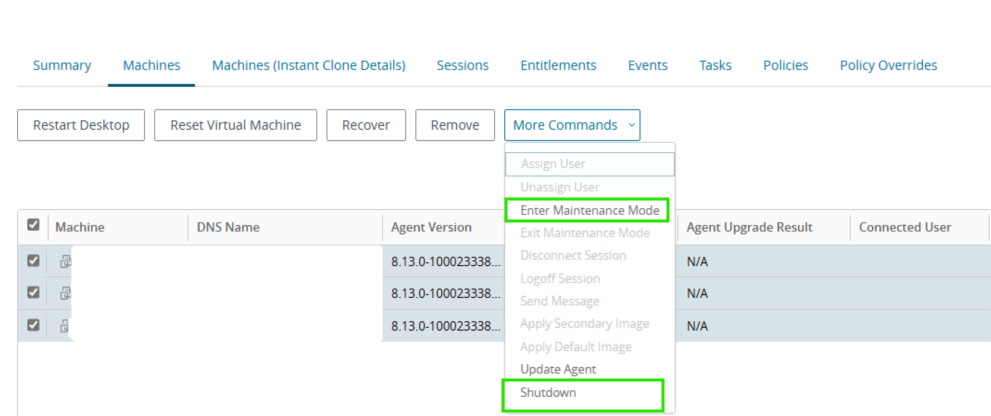
Select Desktops > target pool > Machines > select all > More Commands > Enter Maintenance Mode
By disabling provisioning, we avoid any new machines being rebuilt and generating problem VMs. We then power off all Horizon-managed VMs and the cluster hosts, and vSAN can be prepared for power down.
Disable provisioning on all pools:
via Horizon Admin Console > Desktops > select all pools > Disable Provisioning.
Shutdown all instant clone pool VMs
Select Desktops > target pool > Machines > select all > More Commands >Shutdown. Monitor the progress in vCenter.
At this stage, all Horizon desktops and RDS hosts should be powered off, with vCenter performing no provisioning or Horizon-related actions.
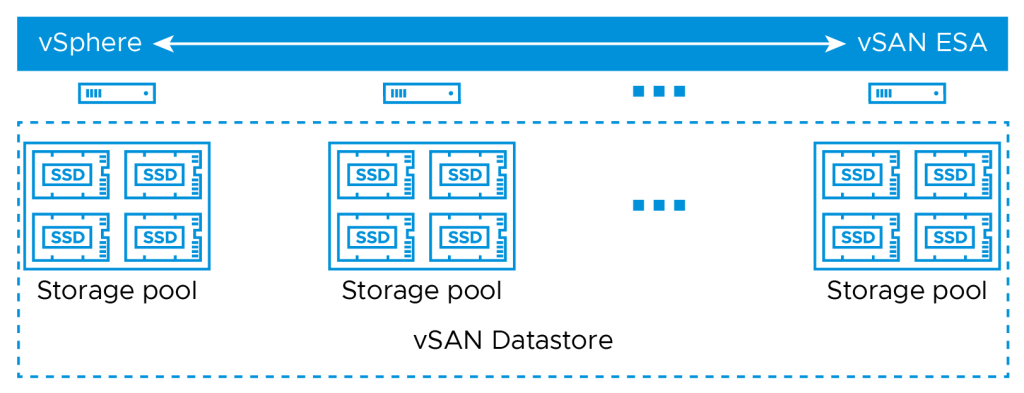
We can now continue with preparing the vSAN cluster and all hosts to shut down. The shutdown wizard will:
Turn off HA
Power off all system VMs
Disable cluster member updates from vCenter for all hosts in the cluster
Pause state changes of vSAN objects
Put each host into maintenance mode
Power off each host
vSAN Cluster Shutdown Wizard
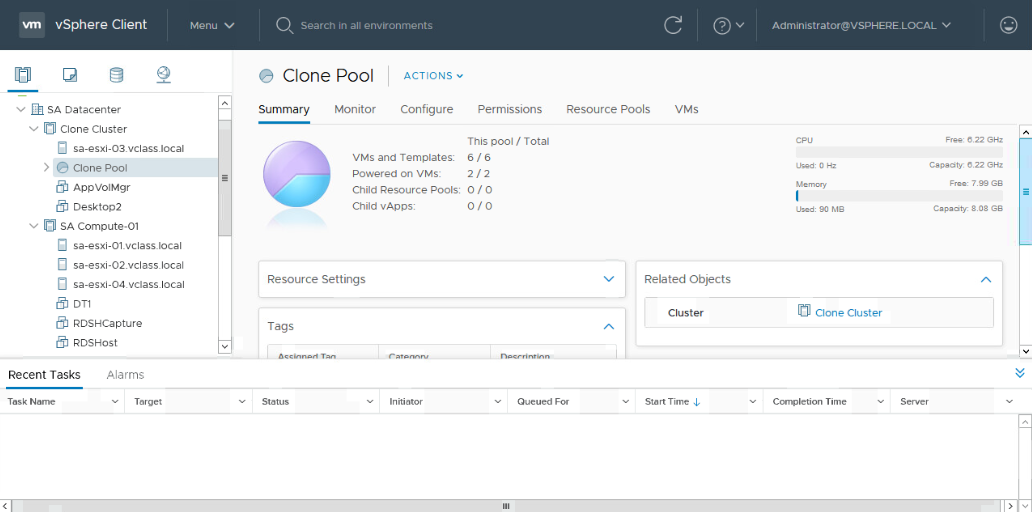
Right click the Cluster object in vCenter > vSAN > Shutdown Cluster.
Note, if Shutdown Cluster is greyed out, browse to Configure > vSAN > Services > Shutdown Cluster
vSAN Restart Cluster
After successful maintenance, power the hosts back on via their iDRAC/iLO/Management interface.
All the hosts will power on and reconnect to vCenter in maintenance mode. To reinitialize vSAN and power the Horizon workloads back on, follow the below steps:
Right click the cluster object vSAN > Restart Cluster.
Once all hosts are participating in the cluster, select the cluster object > vSAN > Skyline Health > Test. Remediate any issues.
Power on Horizon Workloads
Enable ParentVMs for all desktop pool
via Horizon Admin Console > Servers > vCenter > More > Enable ParentVMs.
Enable provisioning on all pools:
via Horizon Admin Console > Desktops > select all pools > Enable Provisioning.
Exit Maintenance Mode for all desktop pools
Select Desktops > target pool > Machines > select all > More Commands > Exit Maintenance Mode
Enable all desktop pools:
via Horizon Admin console > Desktops > select all pools > Enable Desktop Pools.
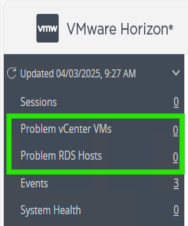
At this stage all Horizon workloads should be powered on and healthy. Review the Problem vCenter VMs for any issues and test provisioning by deleting some instant clone VMs.
Summary
There was some trial and error involved when I initially approached this procedure. The majority of cluster maintenance rarely requires a full power down, so Horizon workloads can be vMotioned between operational hosts. In this instance, we can gracefully shut down all the instant clones. vCenter can manage the vSAN and host power down. There is no need to log on to the hardware until bring-up. I love getting feedback or other tips, so please comment below.
Recently, I was working with a small marketing agency, and they asked if I could assist them with implementing windows security baselines in an effort to gain CIS and ISO 2700 compliance. I’d never heard of these controls. Read about CIS controls here. They provide industry-tested security settings. These settings can be deployed via GPO or MDM for all major Microsoft OS’s, O365, and Azure environments.
Purpose
The below guide explains how to deploy the CIS benchmarks via group policy for an on-premise AD domain. It also explains how to validate your deployment using Policy Analyzer. Additionally, it provides some tips if you’ve never done this type of work and want to introduce some level of CIS compliance into your environment.
1/ Getting started
Define the scope for your deployment. Below are some questions myself and the client discussed to understand what we needed to do (example answers in green). It’s important to know these boundaries, so don’t accidentally deploy controls that aren’t required. Your audit report may guide you here, but remember – any introduction of new security settings is likely to cause some disruption at some point in time, so you should have a good awareness of where you are introducing the change and what services may be affected.
What OS’s are in circulation within the environment? Windows Server 2019 (2x Domain controllers and 12 member servers) Windows 10 1901 (5 client devices). It’s important to know whether you’re working on Domain Member or Domain Controller because server-specific CIS controls are separated by server role.
Do we want to deploy CIS controls to harden servers, desktops, domain controllers or all endpoints? We want to harden the DC’s and Servers only, no client devices.
Can we feasibly introduce the new security controls without any risk to production operations? Yes, create a new group policy OU structure with a test OU and a test virtual server.
If there is risk, how can we mitigate it and what is the rollback plan? Remove the GPO links and rebuild the test virtual server. In production, we’ll need to identify the problematic setting and remediate via group policy or local registry if necessary.
2/ Download the Microsoft SCT and CIS benchmarks
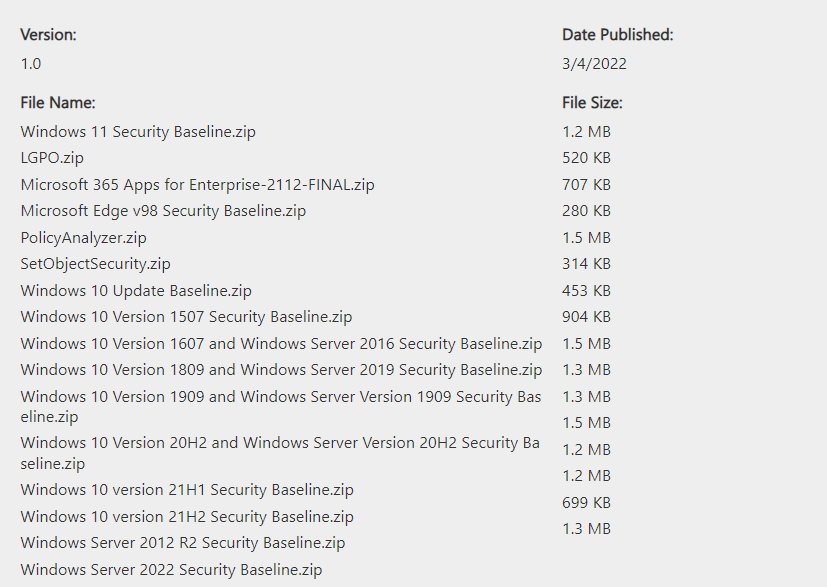
SCT contains the CIS benchmarks for all supported OS’s as well as several tools for helping you implement them. The only tool I had use for was Policy Analyzer.
The OS’s are paired Client + Server by their release cadence so you’ll notice Windows 10 1809 and Server 2019 security baselines in a single .zip
Extracting the baselines for your environment you’ll see the following folder structure.
Documentation: Contains Excel reports covering release notes and change records for the controls.
GP Reports: *useful* HTML reports of the CIS security controls.
GPO’s: the CIS controls as GPO’s, ready for importing into GPMC.
Local_Script: Powershell scripts that apply the CIS controls to the local policy of a machine, useful if you want to test the settings in isolation (and not use group policy).
Templates: ADML and ADMX files used by the CIS GPO’s.
3/ Using Policy Analyzer to review conflicts
At this point you’re ready to compare the incoming CIS controls against your existing GPOs and check for any conflicts. You’ll need to use Policy Analyzer.exe to perform the comparison and I recommend you take a backup of existing, actively used GPOs before getting started.
Take a backup of your existing Group Policy objects that are actively in use: it’s necessary to do this for 2 reasons; firstly, when you generate a comparison report in Policy Analyzer it’s much, much easier to identify where a conflict exists and remediate it when you have your existing GPOs individually compared instead of using ‘effective state’ (more on this in next step), secondly, you might screw up! So it’s always worth having a backup 🙂
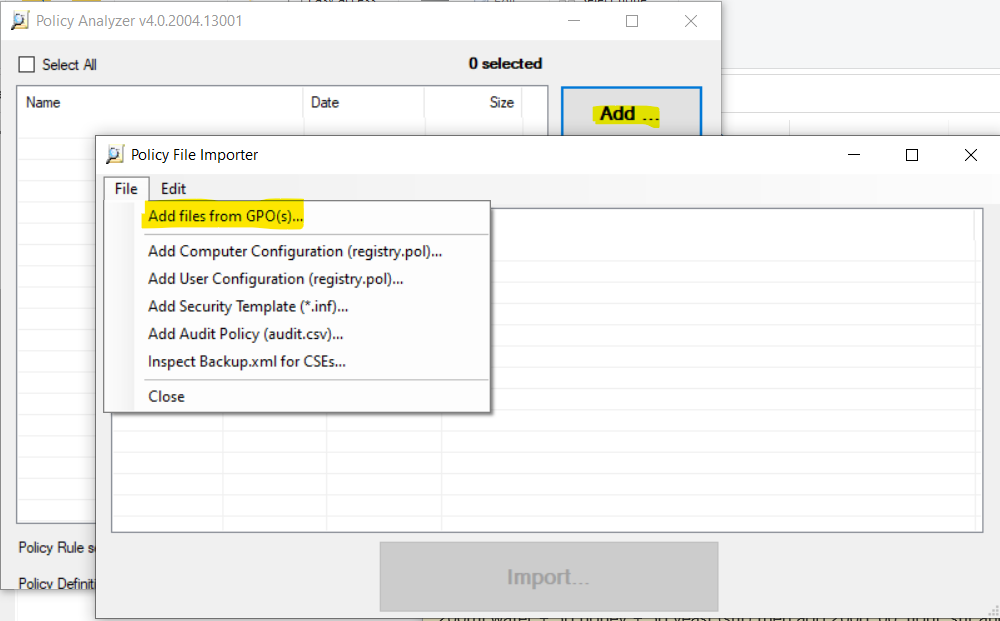
Once backed up, let’s import the CIS GPOs into Policy Analyzer, launch the tool and click Add > File > Add files from GPO(s)…
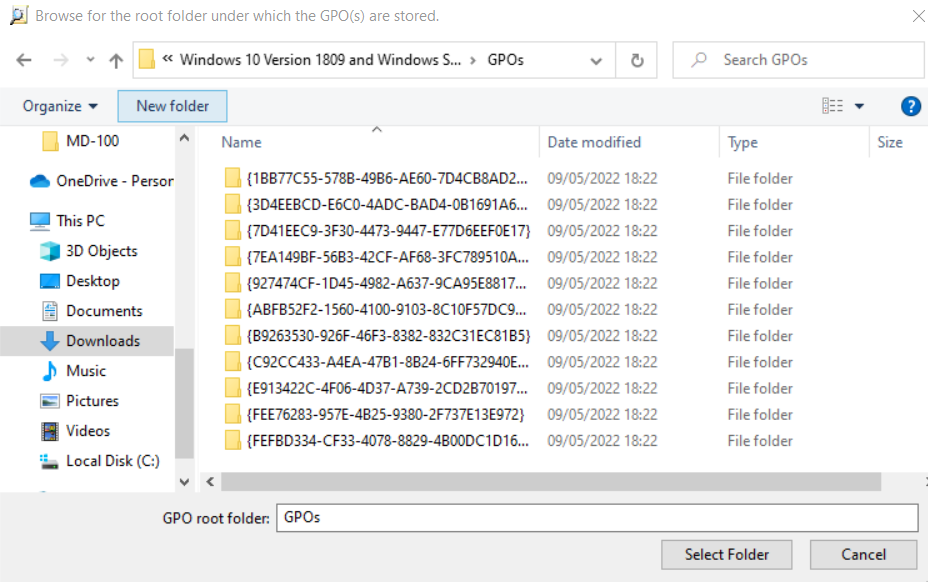
Select the folder containing the CIS controls
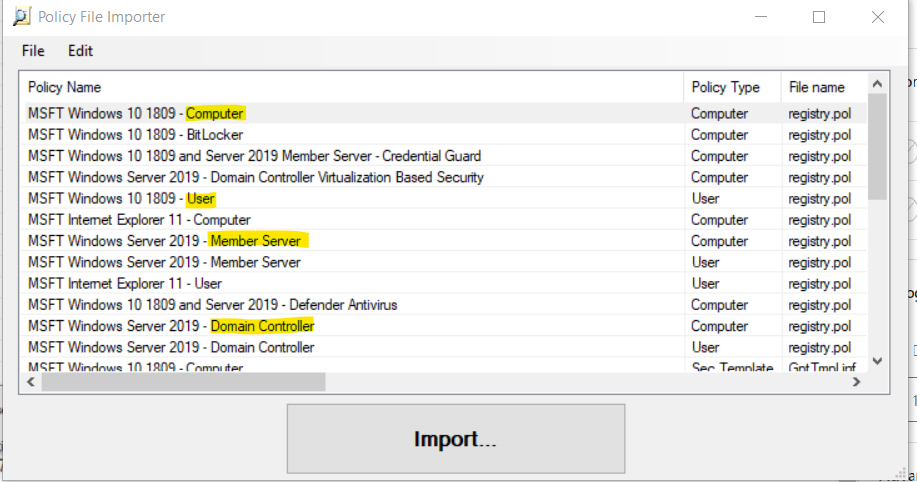
Now select the relevant GPOs for your environment, our earlier scoping exercise should help here and as you’ll see below some policies are for member servers, domain controllers, user settings or computer settings – so be aware of the differences in the targeted objects or role of a given GPO.
You’ll be prompted to save a .PolicyRules file – this is just a reference file for PA.
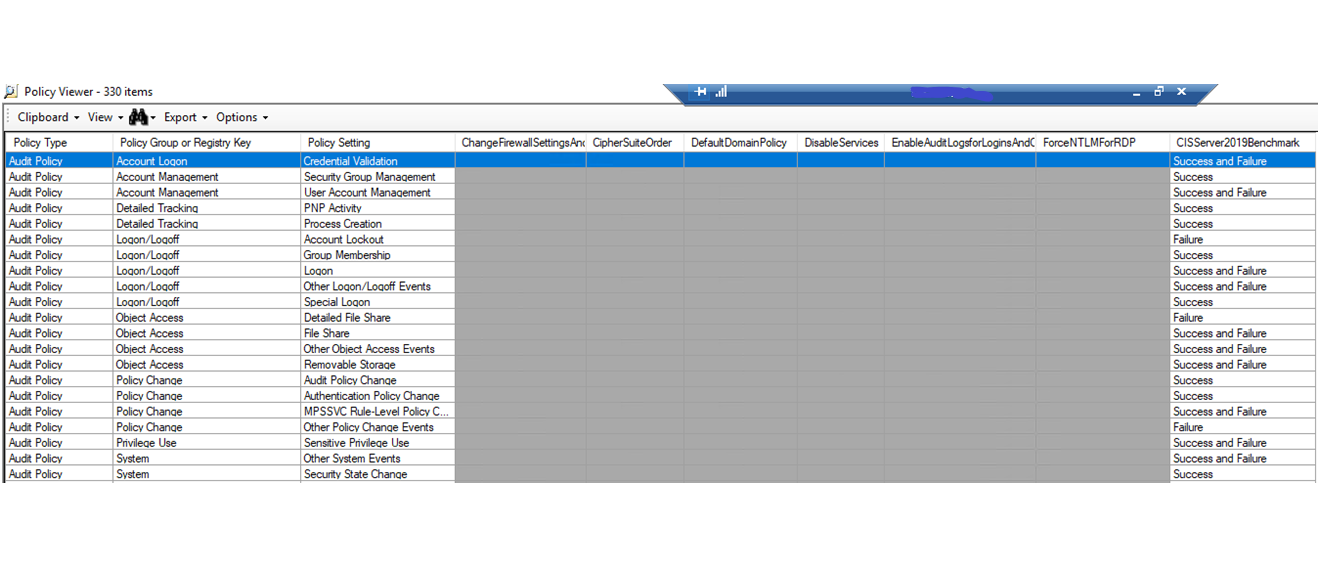
Once complete, you’ll see an entry for your newly imported GPOs and you now have the option to compare the controls to the local machines ‘Effective state’. In the results you’ll see two columns, your baseline (the CIS GPO) and the Effective State (your local machines state with group policy applied). Conflicts are highlighted, Grey is no existing setting is configured.
The default view is useful but it doesn’t show you which of your existing GPOs are conflicting with the CIS controls. To see this, we’ll need to import the GPOs you backed up earlier into Policy Analyzer. To do this, repeat the steps you’ve just taken to import the CIS GPOs, but point to your backed up GPO files and then save the .policyrules file. Re-run the comparison but this time don’t compare to the Effective State, instead select the CIS controls and your existing GPOs and click View/Compare.
The view will now contain a column per-GPO, making it much easier for you to identify which policy contains the conflicting setting and adjust accordingly.
Import CIS GPOs and ADMX/L templates into GPMC
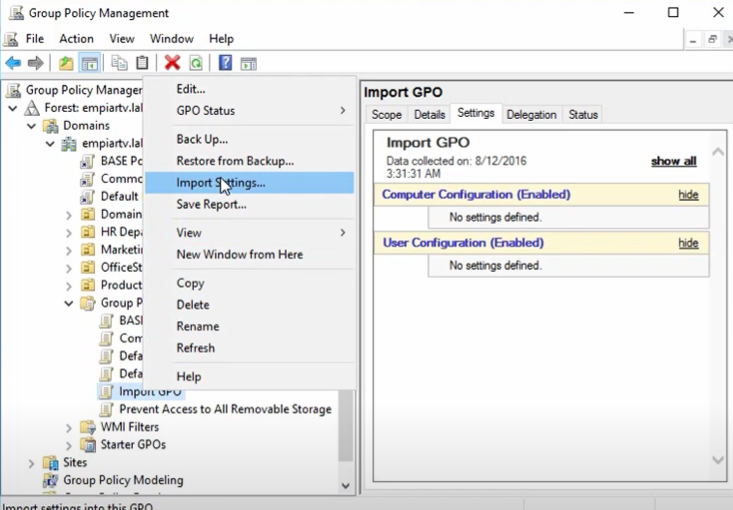
At this point you’ve got the nuts and bolts to perform comparisons and find conflicts. I would recommend you do a Export > All results to Excel to keep a record of your domain state before you start meddling with group policy. Spend time reviewing the conflicts and reading through the new incoming settings, when you’ve resolved the conflicts (either by editing your existing GPOs, or muting the settings in the CIS GPOs) you now need to import the CIS GPO files into GPMC. Here is a useful guide for doing this alternatively, or (slower) you can manually create a new Group Policy Object > Right click > Import Settings and select the CIS GPOs one by one.
Remember to also import the ADMX and ADML templates from the Templates folder into your central group policy store.
Conclusion
To recap, we identified the scope of devices you want to harden and what OS mix operates within your domain. We then extracted the baselines and compared them to the existing state of an endpoint and/or all existing GPOs to remediate conflicts, you’ve imported all the security policies into your GPMC console and are now ready to deploy the controls within your domain.
At this point I would recommend you have some test machines to deploy the new GPOs to and monitor the progress. I hope this post has been of some use to you and good luck. If you’d like to make a donation you can do so below.
*Update 22/01/22 After much effort spent getting this to work at a customer site, it turns out there was never any need to have conditional access enforcing VDI devices to be hybrid-joined. By turning off the conditional access policy that checks the device is Azure-AD joined, there was no longer any issue. Note, if you’re using a zscaler you’ll need to configure source IP anchoring as well.
*Update 31/07/21 After migrating a customer from Appsense to VMware DEM I had to find a new method to perform the hybrid join. The below article now provides two methods for performing the join.
Read this post if you’re having problems performing Hybrid Azure AD join on non-persistent VDI. This post covers the how to configure Hybrid AD join on VDI , how we discovered it was broken and a clean solution to fix it.
The running environment was Windows 10 1909, VMWare Instant Clones on Horizon 7.10, with zScaler proxy (.pac files).
For the solution, click here or scroll to end of article.
How to configure Hybrid AD join and why it might be failing for you…
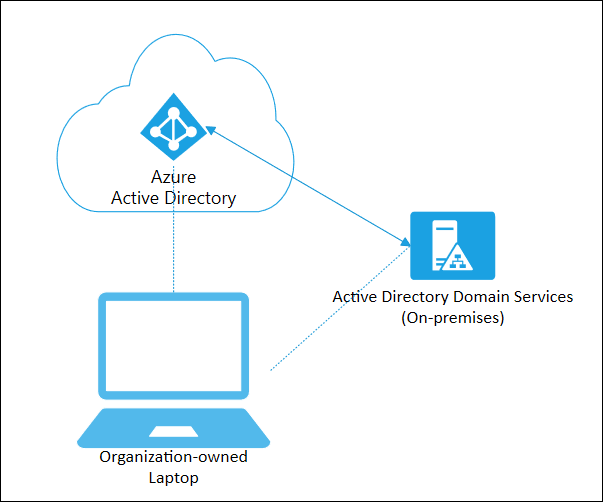
In our case, hybrid AD join was always broken – we just hadn’t noticed because the device join was successful which is all that is required for O365 services to work (Outlook gets a license – everyone is happy!) but the user PRT token (which I’ll refer to as user-join) was failing – which, if you have InTune in place for MDM policies and all that fancy stuff – you may find these devices are broken when the VDI is in use.
Microsoft offer very little guidance on how to implement Hybrid AD join on VDI but Google yields a lot of negative feedback from folks implementing this for VDI. This VMware thread was helpful in our discovery, and the guidance from Microsoft is helpful, but not as detailed as it should be.
Microsoft’s suggestions are:
Implement dsregcmd /join as part of VM boot sequence.
DO NOT execute dsregcmd /leave as part of VM shutdown/restart process.
A .bat file or powershell can perform the join as follows, and configure this to run as a start-up task. Note, the task should be ran under the context of the SYSTEM account, and ensure your network is configured to allow this traffic (see zScaler section).
dsregcmd.exe /join
Master Image
You should ensure your master image does not perform an AAD join at all. You should run the /leave command as SYSTEM account prior to sealing your image and taking a snapshot, although we would often forget to do this. Whether this contributed to the issues covered, I’m not sure. Additionally, some threads suggest your master image should not be domain-joined – in our case, the master image IS domain joined, but was NOT AAD joined.
Use PSExec to perform a /Leave command as SYSTEM account:
Psexec -I -s dsregcmd.exe /leave
zScaler .pac on VDI for Hybrid AD Join
If you’re using a zScaler to manage internet traffic you may find that Hybrid AD join fails because the traffic is sent from the VM’s under the context of the SYSTEM account and if no .PAC file is configured against that account, then it will fail (unless you allow unauthenticated traffic on your zscaler devices). If we also throw into the mix that Microsoft recommend you join AAD during device start-up – your user will not have authenticated to zScaler when the /join takes place, so you must configure this.
On your master image, launch Internet Explorer as SYSTEM account, and then manually configure the .PAC file manually. Download PSTools and then run the following command from an elevated cmd prompt:
The above steps explain how we were configured for Hybrid AD join BEFORE we discovered it was not working. Read on for the discovery, and adjustments we made. Click here for the solution.
How to identify a VM has failed Hybrid AD Join
As a large enterprise with multiple VDI sites managed by different teams, we discovered some sites were performing the /join during the ‘Desktop Created’ stage of the logon process (i.e. once the user is logged In and desktop shell fully loaded) – in these pools we saw the device join was successful, but user join (PRT token)was unsuccessful – this is because the user was not logging into an AAD-joined device, so the device was deemed unauthorized to receive a PRT token.
Open cmd prompt and run: dsregcmd /status
Review the output –note you may also see that the Tenant Name is blank in your output. The device will show as joined, but no PRT/User join had taken place –
Device State shows successful AAD join:
User-join has failed and the AzureADPrt token is not present.
Contrary to MS guidance we experimented with adding a /leave command at logoff – on these pools we saw the object in AAD was updated more accurately in Azure – the ‘Last Activity’ times reflecting the join/leave times of when the desktop sessions were in use. However, the underlying lesson here is that the device must be joined first then the user is logging into an authorized device and a second/join should take place to fetch the user PRT token.
On the pools configured to use a start-up taskwe found the device join would periodically fail – but this became more frequent as time passed until we had complete failure of all devices in a given pool.
VM template objects flooding Azure AD
We searched AAD to compare on-prem device names to their records in AAD and discovered we had a ton of VM’s joining AAD under the machine name of itXXXX – this is the internal template object which is created by ESXi when a new snapshot is published to a desktop pool. AAD was being flooded with these objects every time we changed the snapshot on a desktop pool.
VM’s were joining AAD successfully (device-join only) but their ID did not match their counter-part object in AAD – instead, it matched the internal VM template.
At this point we knew that when a new snapshot was published, a new AAD object was being created with the VM’s template account ID. Additionally, it proved the /join was taking place too early in the logon process (at machine start-up) – and instead of joining the hostname of the VM that is provided by QuickPrep (e.g. PROD-VM-1) the ID of the instant clone template was being used to join the machine to AAD.
To verify this:
Open AAD and search for device name:“it“
Note, this applies to VMware Instant Clones environments only, Citrix and Hyper-V hypervisors will use a different provisioning process, check your vendor documentation to know what to search for)
Template VM objects in AAD –
Duplicate VM device ID’s
Another symptom of this issue was VM’s would recycle their Device ID – we found the same Device ID (after the device had joined AAD) was in use by other VM’s in the same pool. Presumably this is a hangover from previous symptom.
Take 2 VM’s from the same pool, open CMD prompt and run dsreg
cmd /status, compare the device ID’s on both devices – are they identical?
Verifying AAD Join process
To check if your VM’s are joining AAD with an incorrect computer name:
Check the local VM event log Applications and Services Log> Microsoft/Windows/User Device Registration for event ID 335.
Note, the computer name is itXXXX , user SYSTEM.
Let’s recap what we’ve learned so far:
VM’s are joining AAD with the wrong computer name
AAD is populated with stale records for our VM’s
Our VM’s are recycling device ID’s
The User-join (PRT token) is not working
After several hours of toil, testing and swearing, We tried moving the /join to different stages of the logon sequence, but only found Start-up to be ‘successful’ for the device-join. During testing we removed the /join altogether – and low and behold, we discovered the VM’s were still joining AAD – this is because there are 3 scheduled tasks baked into the Windows 10 1909 OS to perform auto-AAD join.
Microsoft don’t tell you this in their VDI guide because they prefer ‘the Community’ to figure it out…they’re real nice like that.
1/ Perform the /join operation TWICE, once at Start-up, and again before the desktop shell has loaded.This ensures the the Device and the User PRT token are both issued succesfully.
2/Ensure the dsregcmd.exe /join operation is managed by your profile management tool. Don’t try to mix combinations of scheduled tasks/group policy/profile tool.
3/ Delete the Automatic Device Join scheduled task. This was the root cause of all our pain. The task will perform a join under user context and has 2 triggers – a ‘special event’ and at logon.
4/Always perform dsregcmd /leave on your master image. Ideally, avoid the master image from joining AAD in the first place.
5/ (Optional) Add a /leave command at logoff of the VM. This is unsupported by Microsoft, the only benefit we found from including this was the ‘Joined’ and ‘Last Activity’ timestamp was kept up to date in Azure AD – but again, not supported.
6/ (Optional) Set the machine GPO ‘Windows Components/Device Registration/Register domain joined computers as devices‘ to disabled. This helps keep things tidy and you can be confident the join is only handled by your profile management tool.
**Alternative Method**
I recently had to decommission Appsense for a customer and move them to VMware DEM. In doing so, the method described above had to be changed. Although DEM can run tasks at Startup of the VM (it hi-jacks the native group policy startup/logoff scripts) which isn’t suitable for performing a /join because the template account for the pool is then joined to Azure AD. Which we don’t want. Thanks to some feedback on the DEM forums, I’ve found the below method works nicely:
1/ Configure a .bat file that has a /leave and /join. You’ll call this as the post-synchronization script when you configure the pool. Example file.
cd c:\windows\system32
dsregcmd.exe /leave
SLEEP 10
dsregcmd.exe /join
2/ Make the file available on your master image, ideally in the C:\ root somewhere and configure it as the post-synchronization script for the pool.
3/ You should now see the devices populate in AAD when the pool is being composed. When a user logs in , because the VM is now ‘trusted’ the PRT token should be issued. Microsoft does not support the /leave as part of non-persistent devices so I’ve ommitted this. It is possible to add a /leave command (perhaps as a shutdown script), but we’ve discovered no issues with leaving the devices joined in AAD indefinitely.
Master Image configuration
Step 1:Delete the Auto-Join scheduled task in Win 10 1909
On your master image open task scheduler: Microsoft > Windows >Workplace Join
Delete the Auto-Join task – this must be deleted and not disabled – because it’s a system task.
The remaining 2 tasks should be left in their default state – they should not require any manual intervention. If these tasks are disabled or not present on your image – then check OSOT or group policy if these are being deleted by an upstream policy.
Step 2:Remove your master image from AAD
Launch psexec from an administrative command prompt using: psexec.exe -i -s dsregcmd.exe /leave
You may see the below exit code 0.
Confirm the /leave was successful by checking AAD – you should not see the machine account, and the /status output should be as below.
/status output when device has left
Step 3:Remove existing itXXXX or stale records from Azure AD
Remove any of the stale device records from AAD. This should include the itXXXX devices , and any VM’s in pools your going to test in.
Step 4 (optional): Bake your user profile configuration into the master image
If you’re unlucky enough to use AppSense or a similar tool – you may have to bake your configuration into the master image. Other profile management tools may not require this step.
Profile Management Tool Configuration
Step 4: Configure the dsregcmd /join operations
Start-uptask:
Configure the 1st /join operation during Start-up of the machine (or machine boot).
2. Scope this to only apply to machines with your VM naming conventions – this ensure the correct devices join AAD, but also prevent the itXXX devices joining (or your master images). If you have no profile management tool, then this might work with scheduled tasks or a group policy object, but we did not validate this.
Pre-Desktoptask:
Perform a 2nd /join operation during the ‘Pre-Desktop’ stage– this is the point at which user authentication has completed, but the desktop is still loading. This should ensure the PRT is issued to the device, and also provides a backup to one of the scheduled tasks (re-sync) which does the same thing.
Has this fixed it for you?
1/ We no longer need to delete ‘stale’ AAD objects – there is only 1 AAD object per VM. Each VM joins to the same AAD object – no duplication, no dodgy device ID.
2/ When a new snapshot is published, we did not see the itXXXX devices appearing in AAD (clean joins!).
2/ User-join was always successful – this is probably because the Auto-Join scheduled task is not interfering with the registration process.
I hope this helps someone, if you find other solutions or suggestions to improve on this find I’d love to know
My tips for saving money, what you’re really paying for, study guide and advice for passing the VCP-DTM 2020 qualification!
The following post covers my personal experience in studying for the Official VMware Certified VCP-DTM 2020, achieved June 2020, the following steps are covered:
Step 1:Consider a vMug Membership
Step 2: Studying for Foundations 6.7 exam
Step 3: VMware Instructor led training [on demand]
Step 4: Preparing and Passing the VCP-DTM 2020 Exam
vMug membership will provide around £650 of overall savings for the DTM certification track and provide resources for a home lab and is a great insurance to have if you fear failing the exam (like I do)…
vMug costs around $200, but do a quick Google for vMug discount codes prior to signing up to save a further 10% on the signup fee.
You save around £550~ on the official VMware instructor-led training [on demand] or In-Class routes.
You get a total of 4x 20% exam discount vouchers – 2x for Foundations 6.7 and 2x for any VCP exam – saving you around £30 per re-sit, if needed. You also receive discounts for VCAP if you’re on that path.
You get evaluation licenses for a broad range of vProducts – including vCenter, Horizon Standard, View Composer and Identity Manager – which covers most of what you’ll need for the DTM route.
Sound great! But what’s the catch?
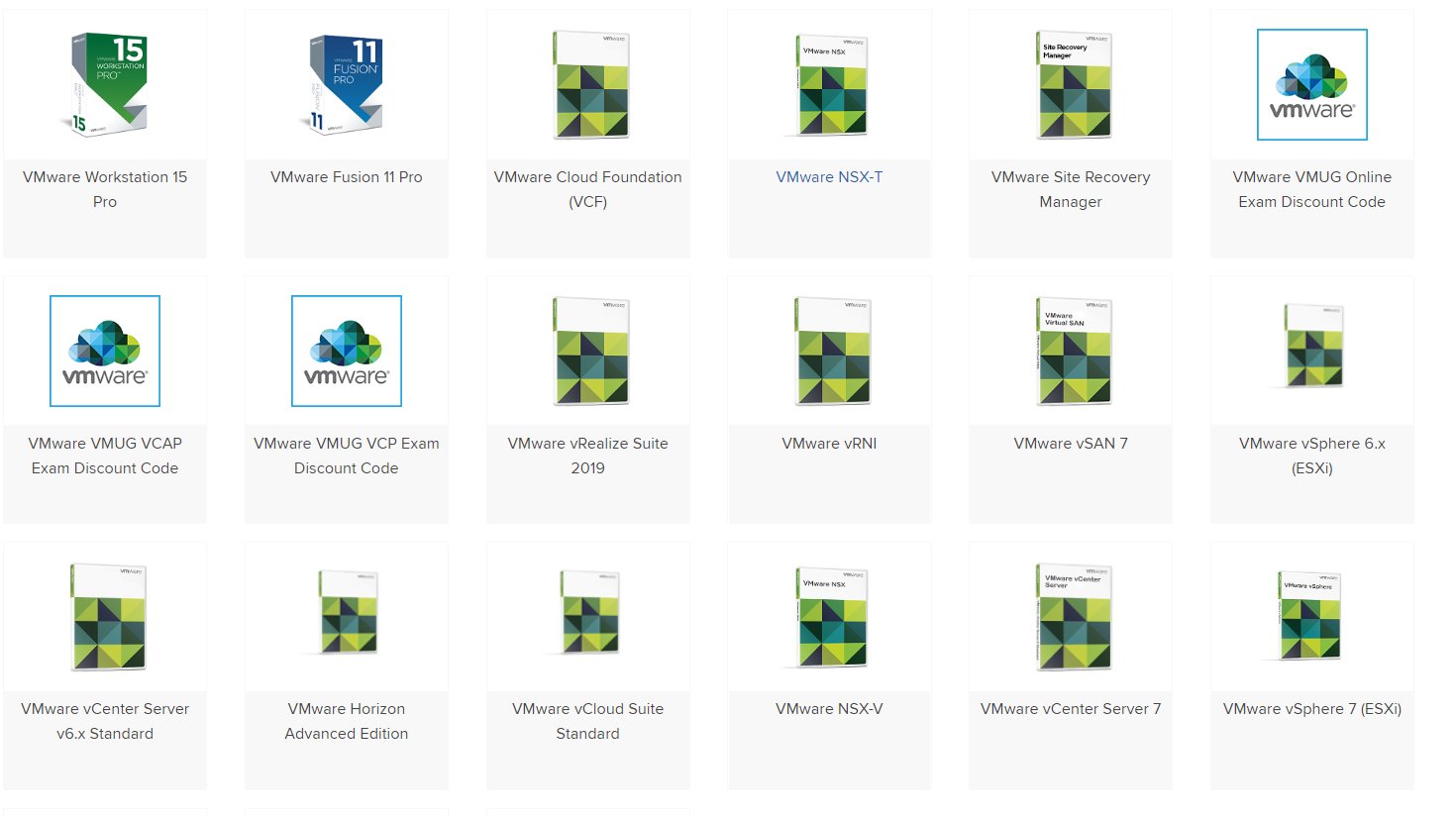
Bad News: vMug Evaluation licenses DO NOT cover the VCP-DTM 2020 blueprint technologies! Considering VMWare want people to have hands on experience with their products, but won’t let you spin up a lab environment at home to use their latest innovations, I found it pretty disheartening to realise I’d spent $200 but wouldn’t be able to setup a home lab for JMP components:
You will not have evaluation licenses forAppVolumes, Instant Clones, UEM, RDSH Apps – these are only available under a Horizon Enterprise license, vMug only provides you Horizon Standard.
Sort of. You do get evaluation licenses for ESXi, View Connection Server, Identity Manager, View Composer and vCenter Server which will let you build a linked-clone lab environment and this will definitely help you . More on this further down.
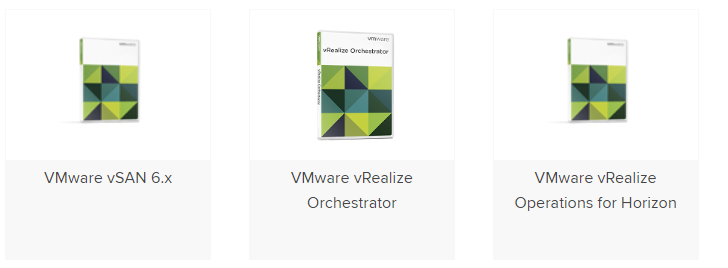
Below pictures of what the software catalogue looks for vMug Advantage members:
It’s worth noting that, you’re experience may be with Horizon, or vROPS, or some other suite of products – but the focus of the Foundations exam is aligned with theVCP-DCV certification path– there are barely any questions on DTM related content. This threw me off (I failed it twice) – so be aware that you basically become ‘primed’ to study for the DCV path by virtue of undertaking the Foundations course.
Naively I had expected the Official Course Guide to provide a decent level of detail for what is covered in the Foundations exam but the book does not cut the mustard. I ended up relying on the below resources far more than the OCG, so below are my recommended study materials in order of preference. Good luck!
Study Materials for vSphere Foundations 6.7 2019
Undoubtedly the best resource you can use if the VMware Knowledge Base ; remember to filter each article by the release version you need. Exam questions are formulated from KB articles, so I recommend prioritising these as your primary material before referencing any related books, websites, third party study guides.
VMware Technical and Whitepapers cover Best Practice, Details Design Documents (DDD’s), Overviews and Explanations of all things VMware. I’d covering each exam topic but equally, taking notes from each paper for real-world application. Ask yourself which vSphere features your current client or workplace utilises and consider the ‘why’ behind each design decision. This’ll make your study a lot more relevant.
VMware Technology Network is a useful forum area moderating by VMware staff and there’s plenty of real world Q&A to reference.
Recommended Study Books
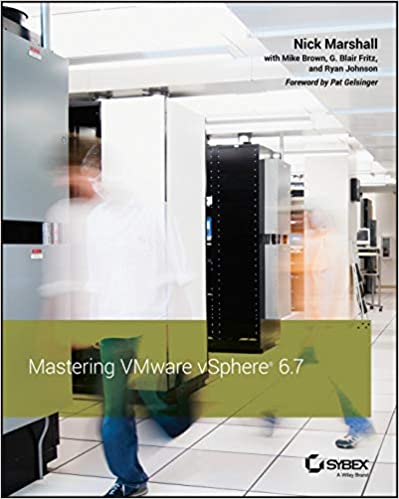
Mastering VMware vSphere 6.7 – Nick Marshall
Useful for: a great deep-dive reference into each feature in vSphere 6.7. Contains implementation steps, explanations and recommended practice for every feature covered in the Foundations exam blueprint.
vSphere 6 Foundations Exam Official Cert Guide – VMware Press
Good for: Giving a primitive understanding of each technology area. However, this book is littered with mistakes – from grammar to incorrect question answers and dodgy screenshots from legacy versions of the web client. It’s written in a conversational tone which is great, but massively let down by its brevity and lazy proofing. I suggest you don’t rely solely on this book (as I did…).
Building A vSphere Home Lab On Your laptop!
This guide to creating a complete VMWare home lab on your laptop is truly excellent. You build an 2-node vSphere home lab and can run it entirely embedded environment on your home laptop. You may need to buy some more RAM to accommodate it , but it’s money well spent and you can utilize your vMug evaluation licenses to run the latest vSphere components at home! In relation to the exam, it is well worth going through the motions installing and setting up the ‘core’ vSphere and Horizon components – this aids massively for both exams – believe it or not, there’s plenty of exam questions (in Foundations and VCP) focused around what happens during installing or what options/steps are built into the install process.
As a guide, I have a Dell XPS 15 i7, 32gb RAM, 500gb SSD (free space) and was able to run 2xESXi node w/ Composer and Connection server.
Step 3: What is the VMware Horizon 7: Install, Configure, Manage [V7.7] – On Demand training ?
Bearing in mind my experience will give a slight bias to this information – I have around 6 years experience with Linked clones, AppVols, and 1yr with Instant Clones and UEM in large enterprise environments. I personally found the training to be a bit below par considering the cost and I had higher hopes considering this is meant to be the ‘Real McCoy’ training bundle.
I paid £3000~ for the On Demand training, and yes that price included the vMug discount – and yes, I did feel like an absolute vMug for paying that. However, given my employers have paid me good contracting rates for several years, it was a small investment in the grand scheme of things, and I wanted to compare how they perform as a training provider and gauge how much new knowledge would be imparted to me for paying that kind of premium.
Course Delivery
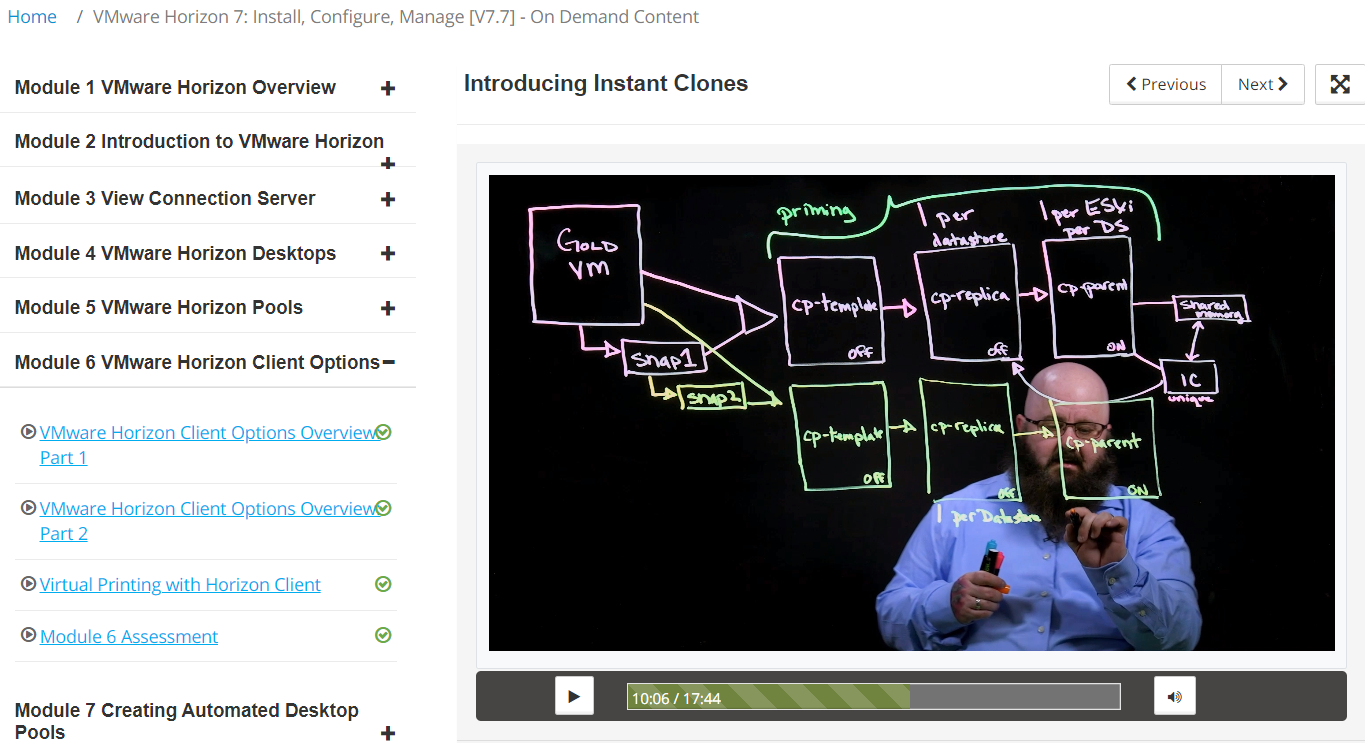
The training modules are hosted on the VMware Learning Zone portal, and broken down into 10-15 min videos with Linus Bourque taking you through (nearly) all components of Horizon, but not all DTM exam topics are covered in the Horizon 7.7 On Demand course. The below screenshot is an example of what to expect.
The delivery is sometimes a bit predictable – the instructor generally parrots what is written down on the slide adding some colour occasionally, however, the slides do cover about 70% of the course in high level, but I’ll reiterate vROPS and Identity Managerare not covered in the trainingor labs. It took me around 16 hours to complete the entire On Demand course.
Assessments
Each module has a few multiple choice questions which do not count towards your qualification. There is a Final Assessment after you complete all the labs and training videos which is covered further down this page.
My opinion?
For the more experienced Horizon admin 5+ years, I think you could skip this and save yourself the expense – but if you’re keen to have the VMware stamp of approval and be ‘fully’ certified, then you’ll have to pay for it. The training does hit the mark for someone with 6 months -1 year hands on experience of Horizon, which is what it’s geared for – you’ll get a good overview of the features of Horizon, what it can do, how it operates and you can walk away with that ‘how can I apply this at work?’ feeling.
For the more experienced administrator, I would avoid paying for it at it’s current price . Particularly if you can combine a home lab setup (for View Composer, Linked Clones) with real world experience in an enterprise. Personally, I will be avoiding paying for anymore VMware training for future VCP certifications. I preach as short sermon on my opinion of vendor training in general at the bottom of the article.
What are the On Demand lab exercises like?
When you give away £3k you half expect to be granted some decent learning experiences in return , after all, the fee is equivalent to 1 term at university – so what do you get?
A vSphere environment with RDSH hosts, AppVolumes Manager, UEM and Win10/Win7 VM’s for creating Linked and Instant Clone pools.
This covers around 70% of what you need to study for the certification, but it doesn’t have any infrastructure for Identity Manager and vRealize Operations Manager – more on this later.
The tasks set during the labs are basic and anyone with 1-2 years experience will have already performed 99% of what is asked of you. Some example tasks include – installing the Horizon Agent into a master image, running OSOT to optimize the OS, create an AppStack and assign it, create an Instant Clone and Linked Clone pool, install UEM (now DEM) and test it – in short, much of the bread and butter tasks to stand up a Horizon environment.
Room for improvement?
Yes. If you want to give customers value for money, I would expect more real-world tasks to be included in the training (isn’t that the idea?). It’s also disappointing that vROPS and vIDM isn’t covered at all in the training or the labs – but accounts for about 30% of the exam? In general, the labs cover installing the components but not ‘from scratch’ as its target audience may have expected. Typically the server or manager element for a service is already setup, and you’re tasked with installing and configuring the agent component into a desktop. If VMware took the time to add a few extra steps to their existing walk through’s it would build a richer learning experience, and I think they fall short on this.
Suggestions for improving the labs
-Install and configure View Composer – create a DB and ODBC, install Composer, point it to the DB, link it to vCenter. This would help prime te understanding of the high level steps needed to configure other Horizon component likeAppVols, vCenter, View Connection Server.
-vROPS and Identity Manager are completely ignored. There is zero information in both the training and labs that covers Identity Manager or vRealize Operations Manager. The exam blueprint includes these topics but you are you’ll have to use the free VMware Hands On Labs (HOL) to familiarise yourself with these technologies and read the KB articles around installation and configuration.
-The DEM (UEM) labs should include how to create predefined settings, writing application templates, how to use the application profile tool and configuring Horizon Smart Policies, to name a few.
-How to update an AppStack and edit it’s properties to mount on different OS’s – valuable for techies involved in OS migration projects!
-How to create an instant clone RDSH farm and app delivery mechanism.
What is the VMware Horizon 7: Install, Configure, Manage [V7.7] – On Demand Assessment?
At the end of the On Demand training course there is a ‘Final’ assessment – don’t be worried by the ‘finality’ of it – it’s a 95 question assessment which repeats all of the questions from the earlier end of module tests – so you’re answering questions you’ve already experienced! Bonus: for each question you have the opportunity to correct your answer twice, so there’s a pretty low chance of failing this, but if you passed each end of module assessment without trouble, you will be fine. As far as I am aware, it can count towards being VMware Certified.
Step 4. Prepare and Pass the VMware Professional Horizon 7.7 Exam to achieve VCP-DTM 2020 Certified Status
If you’ve paid for the On Demand training course, you will receive a free attempt to sit the exam. If you choose not to undertake the training then you’ll need to schedule the exam through Pearson Vue and pay $250 per take. If you fail, you have to wait 7 days before your next resit.
Is the On Demand training enough to sit the exam immediately after completing it?
No it’s not, before you start revising for VCP-DTM 2020, watch the video series: Horizon 7.7 Professional Exam Prep in the VMWare Learning Zone. The video cites numerous VMware papers to reference for revision and as a silver lining, the presenter makes several exam question slips along the way .
My usual tact is to read the ‘Install/Configure/Overview-flavour’ KB articles of the given topic and make notes from these and then refer to books and third party study guides to reinforce your notes. Also, try to image the type of exam question that could be formulated from the KB article you’re reading.Equally, VMware can’t test people deeply on technologies that aren’t easily accessible through vMug or an evaluation license – in our case Instant Clones, AppVolumes, UEM and RDSH – so work within these limitations by not pouring hours into the edge-case issues or configurations – because it’s likely it won’t get covered. Remember it’s a Professional level cert, not Expert/Architect/Specialist.
I would personally recommend trying to answer the following questions for each technology area in the blueprint, and also refer to the ‘By the end of the training candidates should be able to‘ list which is available alongside the blueprints for the training courses (not the exam blueprint). This list is included in my study notes (highlighted yellow bullets) available below.
For example, for AppVolumes:
What are the OS and database minimum requirements for install and/or any pre-requisites?
How do you install the manager/agent and what does a typical/custom/complete installation include?
How do you perform routine operations (e.g. creating, updating, deleting an appstack).
What are a few typical troubleshooting issues you might come across with this technology whilst installing/configuring it OR whilst deploying/using it? e.g. Appstack not mounting, what happens when a user vs computer assignment conflicts, writable volumes not attaching and so fourth, what causes the agent component to fail connecting to manager/server, and so forth.
I hope you’ve found this article useful in deciding whether to study the VCP DTM 2020. This concludes the article, but below are my thoughts on vendor training and how it could be improved. If you have an opinion on that, I would be keen to hear it
The following is not targeted at VMware , but IT vendors in general and their training methods. Most enterprise IT vendors have a team of staff with 100’s of years of combined experience between them; so why do the customers and learners continue to be subject to unimaginative examination and training experiences? Can you remember an Associate, Professional or Administrator level certification that gave you raw, technical skills that you were able to apply at work? I can’t. It’s pretty unimaginative and lazy in 2020 to be expecting people to memorise minimum requirements or what steps are correct to perform action X? – It risks the brand reputation and risks losing your target audience’s interest in the vendor/technology/IT, so why do vendors continue to fall into this trap? What purpose does memorising a bunch of settings serve that is not replaced by Google?
A thought; we live in the attention economy, so getting 100% of someones attention to read your course guides, study your products and write about it online (the irony is not lost on me) is massively valuable – look at the click bait industry! IT vendors have willing participants who will voluntarily pay to indulge in their product developments, buy their books and pour hours of energy into the hope it will give them cutting edge skills – so why do vendors not capitalise on this? Training presents an opportunity to convert a learner/customer into an ambassador/salesman/woman but only if the recipient receives what they are looking for or what they have paid for – real world, bill-paying skills. If vendors took time to tap into their in-house support functions and correlate what common problems they see with their products, understand what real world customers are doing with their tech and how it addresses business needs, then ask themselves, how can we incorporate this into our training? that would be a good start.
I feel there is a gaping void in the lower-tier certs to address this and I’m yet to study a cert from any vendor that has broken this mould. I can’t speak for VCAP, CCNP, MCSE, CCEE level certs as I haven’t worked on these yet (and my expectations are already marred – see the problem?). The age of the Pavlovian memory games must end!
During a desktop login, often you need something to complete before another thing commences, this is often referred to as the execution order or login sequence.
Synchronous and Asynchronous processing is a tool that can help tweak the order in which a login is executed. The below example refers to the Application Launcher module in Profile Unity and the information is taken directly from Liquidware Support.
Asynchronous = Script 1,2 and 3 are executed all at once and left to run their – launch and forget about it! These scripts run as the rest of the desktop continues to load.
Synchronous = follow a predefined order. In Profile Unity the sequence number in the drop down menu defines when the script launches. Of course this is also dependent on the Filter that’s in play.
Question and Answers on Profile Unity Execution Order:
If Asynchronously is not selected the logon process will be paused until this process is finished and exited) – Does this mean that ProU will wait until ALL non-Asynch scripts are completed before it moves onto the next module?
Yes that is correct. The non-async script will wait until finish before launching next non-Asynch script and it will wait to finish before moving on to next module. (Note: the script could be launched During and After configuration).
For example, if we have 10 scripts, 5 of them with Asynchronous not checked, does ProU group these 5 scripts together and start them all at once (or by their ‘order’..?) and then wait for them to complete?
It starts them one by one and waits for them to complete before starting another script.
Profile Unity Login Sequence:
Computer Start-Windows load
Computer GPOs load
Windows Startup script – LwL.profileunity.client.startup.exe – This script updates the version of PU checks make sure there is no bad userinit.exe registry key in place etc.
(Idle waiting for user to login)
User login
User GPO’s run applying to the user
(After they finish running/applying)
userinit.exe runs
Pre-ProfileUnity logn scripts run (PU module- User defined scripts)
Client.exe and all modules from configuration (Left to right):
.
.
.
Application Launcher runs
(if Asynchronously is selected it will load next script/module without waiting for it to finish)
(if Asynchronously is not selected the logon process will be paused until this process is finished and exited)
Rest of the modules are loaded (Left to right)
.
.
.
Post-ProflleUnity Logon scripts are run (PU module – User Defined Scripts)
.
Then ProfileUnity client loads c:\windows\system32\userinit.exe which is actually desktop and explorer.exe
.
Then we run any rules that were marked to run (Post logon) that could be portability/printers/drive mappings etc.
Debugging Tool?
This tool can be helpful for debugging Profile Unity login issues
The following post runs through how to install and package Bloomberg Professional for a VDI environment. The below example uses Liquidware’s FlexApp to do this, but the ideas below are applicable to AppVolumes with VMware DEM to manage the post-deployment script.
Version: This is intended for users of Bloomberg Anywhere and covers how to package and deploy Bloomberg Professional (Full Terminal).
Bloomberg Professional contains Office Tools (MS Office Add-In) and a full standalone desktop client.
2. Run the installer on your provisioning VM selecting Private IP Network as the environment type.
3. Launch the software and click past the connection wizard until you reach the login screen – you don’t want your users to see/do this!
4. Bloomberg has minimum requirements of Read/Write to the following HKLM registry key and subkeys. If you have UAC enabled, you need to set permissions against these keys to allow users R/W access to:
These permissions can’t be captured using AppVolumes or FlexApp because they’re machine-level settings, so we need to use a post-deployment script to add the permissions to the registry after the app has mounted to the desktop at logon time.
There’s a few methods for doing this and at the time we
Configure a post-deployment script using subinacl
The following script should be saved as a .bat file.
For AppVolumes – ideally you should use DEM (formerly UEM) to run the script elevated, at logon or you may need to use Group Policy to run a logon script and scope it against the Bloomberg users.
Another (untested!) option, you could try editing the snapvol.cfg file within AppVolumes – if this works for you, please let me know!
The below can be copied into a .bat file to be executed after the application has been deployed to your VDI desktop(s).
1. Ensure subinacl and the .bat script sit in the same folder, ideally your netlogon share. If storing elsewhere, ensure the logged on user has rights to read/execute from that location.
2. Typically Bloomberg allows you to perform an APOD creation – this installs a generic license key which then lets a Bloomberg Anywhere user log in. If you need to configure this follow these steps: once you’ve installed the app on your capture VM, type CONN in the Bloomberg window to see the connection wizard. Under the Connections tab, click Submit. This will create a generic key code and allow the user to login using their Anywhere login creds













 All things IT, EUC and Virtualization
Leave a comment